

Della Robbia Pottery
The Della Robbia Pottery of Birkenhead (1894–1906) was arguably the art pottery that most fully practised the ideals of the Arts and Crafts movement. Its boldly coloured sgraffito vases, chargers and plaques, inspired by the Italian Renaissance and by Art Nouveau, were sold through Liberty and Morris & Co., and the pottery enjoyed royal patronage.
AD Antiques has specialised in Della Robbia for over 30 years, handling work by the pottery’s finest decorators, including Charles Collis, Ruth Bare and Annie Jones. Every piece is guaranteed as described, with a full condition report. Read our guide to Della Robbia below the stock.
Subscribe for updates from AD Antiques
Tell us what you collect and we'll keep you posted.
Stock for sale


A guide to Della Robbia pottery
The pottery and its ideals
The Della Robbia Pottery was founded in Birkenhead, across the Mersey from Liverpool, by the painter Harold Rathbone (1858–1929) and the sculptor Conrad Dressler (1856–1940). Production began in 1894 in workshops off Hamilton Square. It was named after the Della Robbia family of 15th-century Florence, whose glazed terracotta Rathbone admired.
Harold Rathbone ran the decorative workshop and the business. A pupil of Ford Madox Brown, he was steeped in the ideas of William Morris and the Pre-Raphaelites.
Conrad Dressler led the architectural department, making relief panels and fountains. He left in 1897 to found the Medmenham Pottery.
Carlo Manzoni (1855–1910), an Italian-born sculptor, was briefly involved in 1894, ran his own Granville Pottery in Hanley, then returned around 1898 and was the leading artistic figure until the pottery closed.
The pottery put Arts and Crafts principles into practice. It used local clay and local labour, trained young local people, many of them women, as decorators and paid them a living wage. It even employed an artist known as "Shirley", who had profound disabilities and painted with his mouth.
Those ideals made the work expensive to produce. Despite royal patronage and retailers such as Liberty and Morris & Co., the pottery never became profitable and closed in 1906.
Sgraffito and style
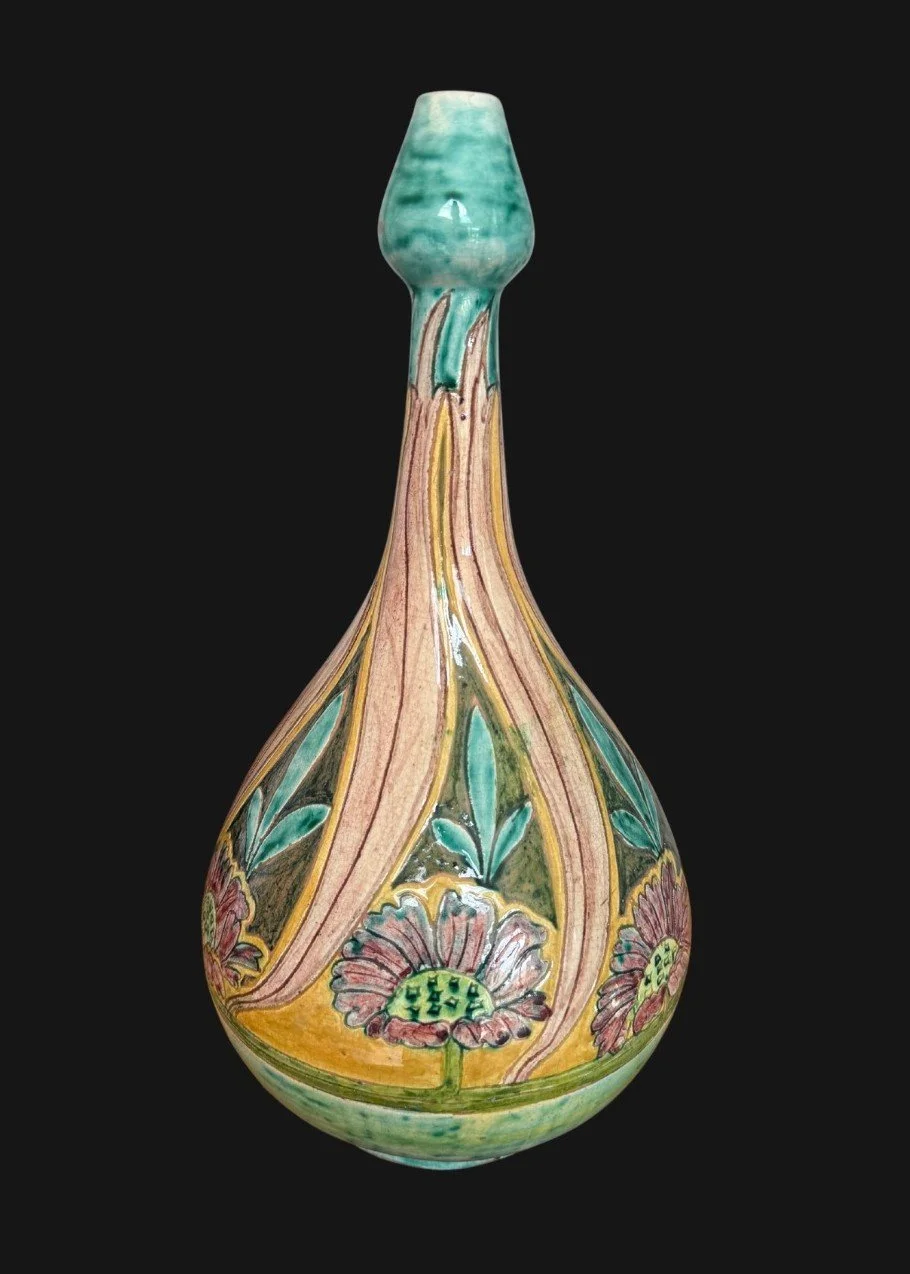
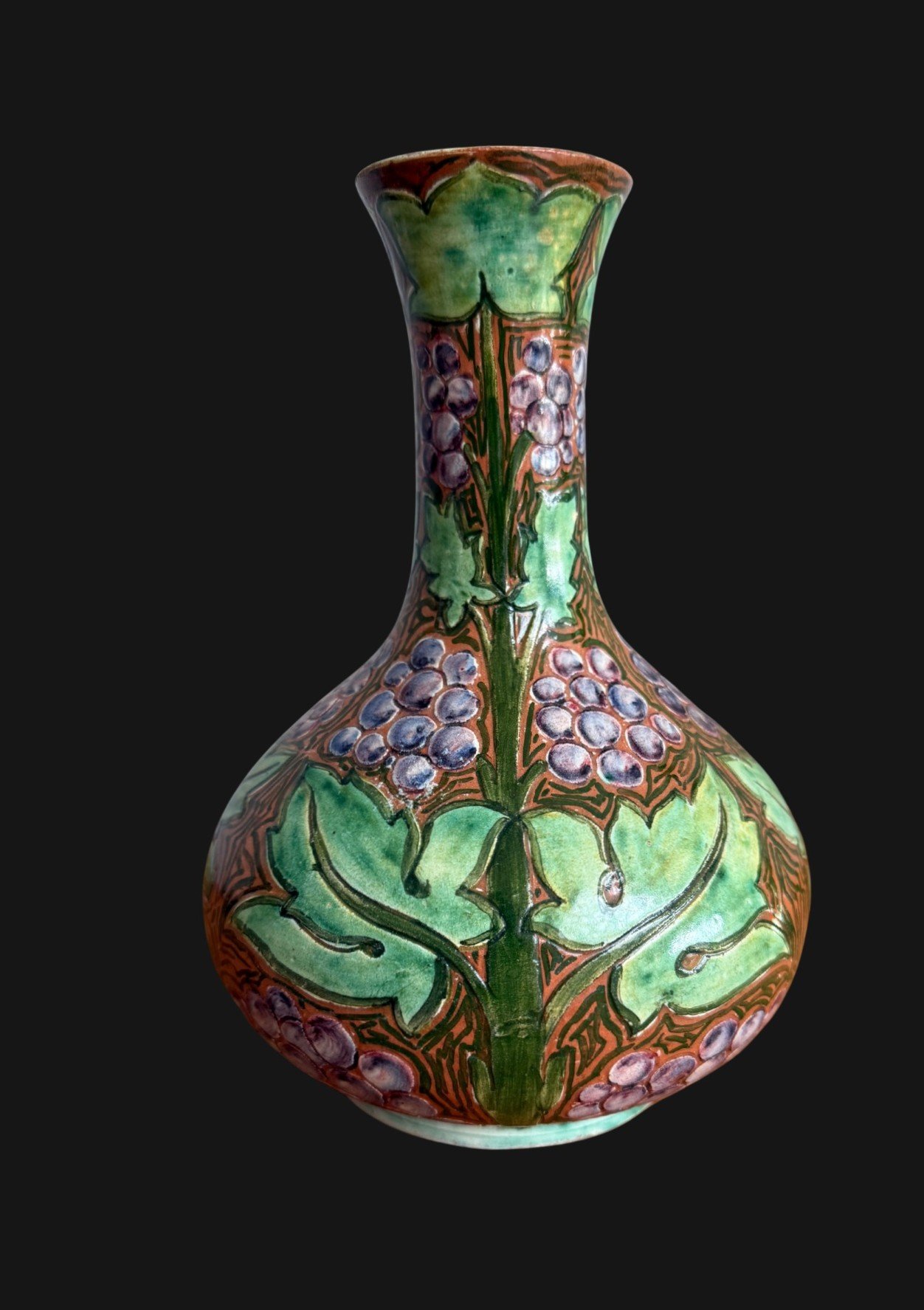
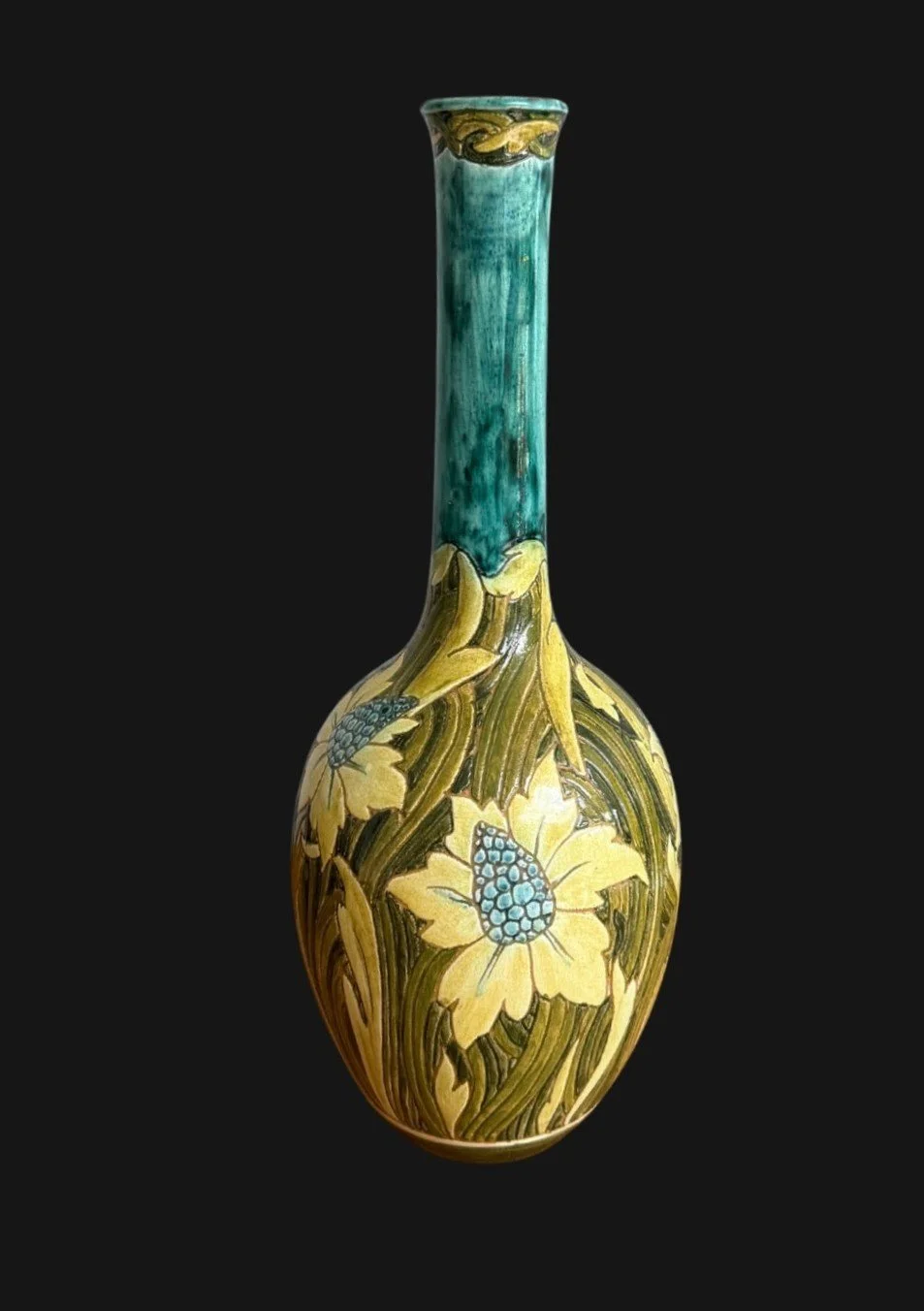
Most Della Robbia is red earthenware decorated in sgraffito. The pot was coated in a creamy white slip, and the decorator scratched the design through it to reveal the red body beneath. The design was then painted in rich, often translucent lead glazes: greens, blues, yellows, ochres and turquoise.
Because every piece was incised and coloured by hand, no two are the same, and the quality of the drawing varies from decorator to decorator.
Italian influence. Early wares drew on Renaissance maiolica and the Della Robbia family's work, with scrolling foliage, grapes and vines, and heraldic and figurative panels.
Art Nouveau. Later pieces, especially by Charles Collis, have flowing stylised flowers, tulips, roses and heart-shaped leaves, some close to the Glasgow Style.
Forms. Vases, chargers and plates, jugs, bowls, candlesticks and clock cases, plus architectural plaques and relief panels from Dressler's department.
The decorators
Della Robbia decorators usually incised their initials or monogram on the base, so many pieces can be attributed. The name of the decorator is one of the biggest factors in value.
Charles Collis – the pottery's most celebrated decorator, known for bold Art Nouveau designs. He later worked for Doulton Burslem and Pilkington's.
Ruth Bare – known for fine, detailed sgraffito, including ribbons and shamrocks.
Annie Jones and Hannah Jones – accomplished decorators of vases and chargers.
Cassandia Annie Walker (CAW), Liza Wilkins (LW) and Percy Jacques (PJ) among others.
Carlo Manzoni (CM) – his later pieces, often called "Manzoni vases", are scarce.
Designs were often by Harold Rathbone himself, with the decorators interpreting them freehand.
Marks and identification
Della Robbia is usually incised on the base with the letters D and R either side of a sailing ship, the pottery's emblem. Alongside it you will often find:
the decorator's initials or monogram (for example C for Charles Collis, RB for Ruth Bare);
sometimes a date, a shape number or the designer's initials;
on some pieces, "Della Robbia" or "Birkenhead" written out in full.
The red earthenware body, visible where the slip has been cut away, is a useful sign of genuine Della Robbia. Pieces from Carlo Manzoni's Granville Pottery in Hanley carry different marks and are a separate, rarer area of collecting.
Condition, restoration and value
Della Robbia's soft earthenware chips easily, especially at rims, handles and the edges of the slip, and the glazes can craze. Any restoration reduces value, so original condition is well worth paying for. Good modern restoration is extremely hard to detect. It can be invisible to the eye and to the touch, and often only a specialist with the right experience and equipment will find it.
Auction houses frequently lack this specialist knowledge, and their condition reports can miss restoration altogether. We strongly advise anyone buying Della Robbia, especially at auction, to have the piece examined by a specialist first.
The things that most affect value:
Decorator. Pieces by Charles Collis and the other leading decorators command the highest prices.
Quality of the sgraffito and colour. Crisp, confident drawing and rich, well-fired glazes make a large difference.
Design. Strong Art Nouveau and figurative designs are more sought after than simple foliage.
Size. Large vases and chargers are rarer and more valuable.
Condition. Firing faults are accepted by collectors. Later damage and restoration reduce value and must be disclosed.
Every piece AD Antiques sells is guaranteed as described, with all condition issues reported, including invisible restoration.
Buying and selling Della Robbia with AD Antiques
Buying. Our current Della Robbia stock is shown above, and our archive holds many pieces we have sold, a useful reference for collectors. Every piece is guaranteed as described, with complimentary packing, fully insured worldwide shipping and a 14-day money-back guarantee.
Selling. We buy single pieces and whole collections, with immediate settlement and no vendor's commission.
Buying at auction? We act as agent for private collectors, inspecting pieces before the sale, reporting on condition and restoration, and bidding on your behalf. See our specialist services.
To discuss a piece, email alison@adantiques.com or call +44 7811 783518.
Frequently asked questions
What is Della Robbia pottery?
Art pottery made in Birkenhead between 1894 and 1906, best known for vases and chargers decorated in sgraffito and coloured glazes. It is not the same as the Italian Renaissance Della Robbia workshop it was named after.
How do I identify Della Robbia?
Look for the incised DR and ship mark on the base, usually with a decorator's initials, and for red earthenware showing through the cut-away white slip. We are happy to look at photographs.
Who was the best Della Robbia decorator?
Charles Collis is the most sought-after, but fine work by Ruth Bare, Annie Jones and others is also keenly collected.
Do you buy Della Robbia?
Yes. We buy single pieces and whole collections, with immediate payment and no commission.
Can you value my collection?
Yes. We provide written valuations for insurance and probate, from £200.
A Perfect Gift for the Pottery Enthusiast in your life…. or a hint to those who find you difficult to buy for!
Any denomination can be produced and can be used in full or part payment to any item on the site.
The voucher can either be emailed or a physical copy posted.